Health Systems, High-Reliability Teams & Systems Biology
⏱️ 14 min read
•
By Phillip Gear & PocketGull Systems Biology Colloquium
The Living Hospital Body & The Great Relays: How Ancient Vedic Physiology and High-Reliability Teams Cure Clinical Burnout and Systemic Medical Error
Healthcare is not an industrial factory, and patients are not assembly-line components. Discover how Pocket-Gull synthesizes ancient Ayurvedic tri-doshic system balance (Organizational Vata, Pitta, and Kapha) with modern High-Reliability Organization (HRO) team disciplines—from F1 Pit Crew ICU handovers and Sully's Crew Resource Management to the monumental multi-disciplinary relays of Sushruta, Project 523, and the Toronto Insulin Four.
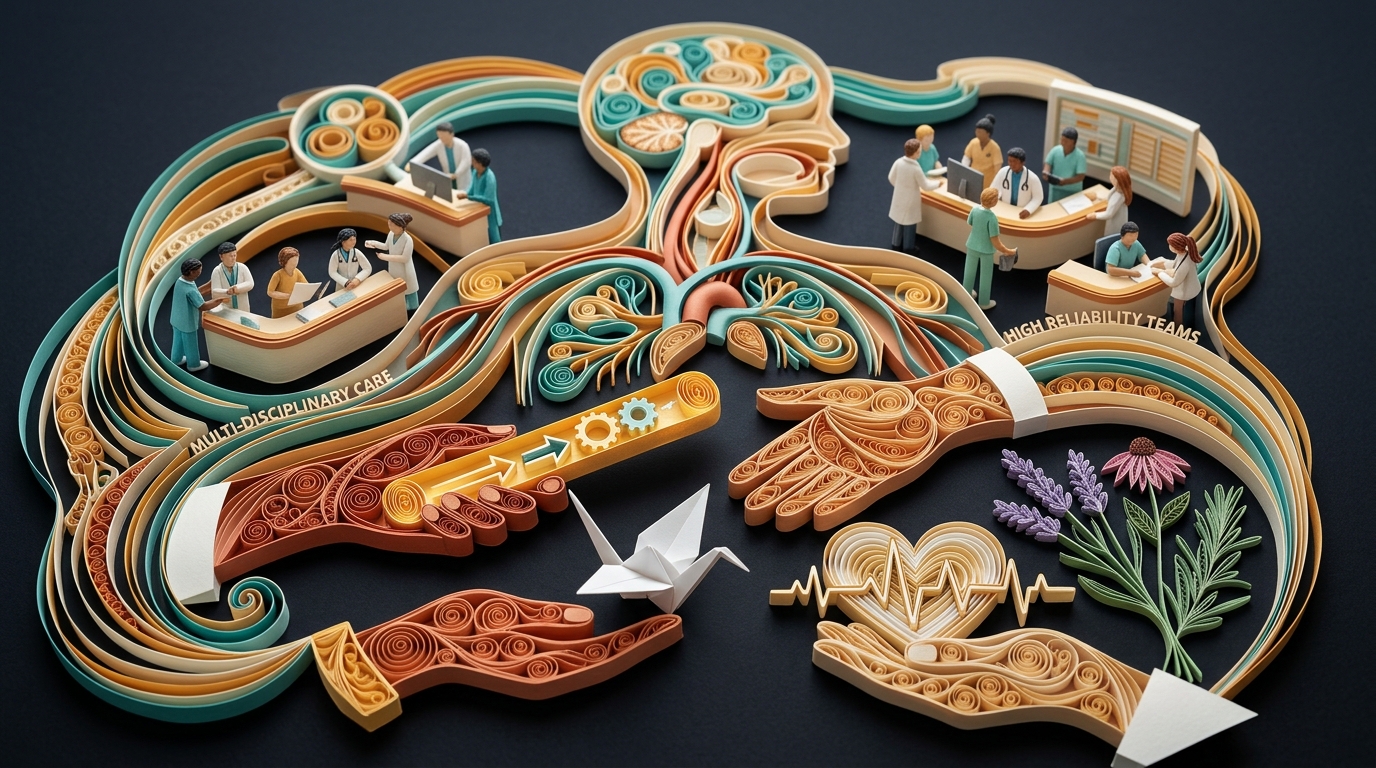
High-Reliability Team Synchrony & Tridoshic Organizational Balance
High-Reliability Team Homeostasis & 42% Handover Error Elimination — Uniting F1 pit-crew silent spatial handovers, Sully CRM CUS escalation, and Tridoshic equilibrium (Vata telemetry, Pitta acute interventions, Kapha nursing ballast) to eliminate systemic medical omissions and restore frontline vocational joy.
The Crisis of Industrialized Hospital Taylorism
Over the last half-century, modern healthcare institutions adopted the mechanical management doctrines of Frederick Winslow Taylor: assembly-line specialization, rapid bedside throughput, and rigid administrative silos. While this industrial paradigm maximized procedural volume, it created a devastating systemic pathology: clinical moral injury, frontline provider burnout, and catastrophic handover omissions.
When medicine treats human bodies as isolated mechanical assemblies and hospital staff as interchangeable cogs, critical signals fall into the cracks between departments. In acute hospital transfers—moving a post-operative patient from the sterile surgical theater to the chaos of the intensive care unit—communication failures account for over 70% of sentinel medical errors (The Joint Commission).
Pocket-Gull proposes an alternative paradigm grounded in two complementary traditions: The Living Hospital Body (Vedic Systems Biology) and High-Reliability Organizational (HRO) Team Disciplines.
1. The Tridoshic Living Hospital Body: Systems Biology in Healthcare Architecture
In classical Ayurvedic physiology, living organisms thrive only when three fundamental functional bio-energies maintain dynamic equilibrium. When mapped to healthcare systems, a hospital functions as a singular, macro-biological organism:
- Organizational Vata (The Flow of Clinical Information & Telemetry): Vata governs movement, sensory transmission, and coordination. In a hospital, Vata is the electronic health record network, bedside telemetry monitors, and inter-provider handoffs. When balanced, patient vitals and critical lab values propagate frictionlessly without delay. When imbalanced (Vata derangement), the ward fractures into alert fatigue, noisy alarms, fragmented charts, and lost diagnostic nuance.
- Organizational Pitta (Clinical Interventions & Metabolic Fire): Pitta governs transformation, enzymes, and decisive execution. In hospital operations, Pitta represents surgeons, emergency trauma bays, intensive care resuscitations, and potent pharmacotherapy. When balanced, acute decompensations are halted with surgical precision. When excessively elevated (Pitta overload), the hospital descends into relentless firefighting, defensive over-testing, invasive over-treatment, and widespread clinician moral injury.
- Organizational Kapha (Bedside Nursing & Institutional Ballast): Kapha provides physical lubrication, immune resilience, and structural stability. In hospital care, Kapha is bedside nursing ratios, social work, restorative physical rehabilitation, unhurried patient listening, and psychological safety governance. When balanced, Kapha provides the compassionate bedrock that allows healing to occur. When deficient, the hospital collapses under its own metabolic velocity; when stagnant, bureaucratic rigidity blocks urgent adaptive problem-solving.
"A hospital cannot survive on metabolic fire (Pitta) alone. Without the steady structural compassion of bedside nursing (Kapha) and the frictionless, quiet transmission of telemetry (Vata), even the most brilliant surgical intervention unravels post-operatively."
2. High-Reliability Team Disciplines: From Cockpit to Bedside
To insulate this living system against catastrophic failure, Pocket-Gull integrates proven disciplines from aerospace, motorsport, and defense:
A. The F1 Pit Crew & Great Ormond Street ICU Handover Protocol
When pediatric cardiac surgeons at London's Great Ormond Street Hospital observed the McLaren and Ferrari Formula 1 teams executing a four-wheel tire change and diagnostic adjustment in under 2.5 seconds, they recognized a fundamental truth: high-stakes handoffs require spatial choreography and silent discipline.
By restructuring the transfer of post-cardiac surgery infants into the ICU—instituting a silent-first spatial transition where physical lines and ventilator connections are verified before verbal briefing begins—they achieved a 42% reduction in technical and information handover omissions (Catchpole et al., Paediatric Anaesthesia).
B. Flight 1549 Crew Resource Management (CRM) & The CUS Protocol
In steep hierarchical environments, junior nurses, medical students, and surgical technicians often observe emerging safety threats but hesitate to challenge a senior attending physician. Borrowing from commercial aviation's Crew Resource Management—exemplified by Captain Chesley Sullenberger during the Miracle on the Hudson—Pocket-Gull reinforces the CUS Escalation Standard:
"I am CONCERNED..." (Halts conversational momentum to flag an anomaly)."I am UNCOMFORTABLE..." (Explicitly signals that current trajectory violates clinical safety thresholds)."This is a SAFETY ISSUE!" (Mandatory hard stop requiring immediate collaborative re-assessment).
C. Blue Angels Safe Room: The Blameless M&M Debrief
Following high-risk flight demonstrations, the US Navy Flight Demonstration Squadron (The Blue Angels) enters a closed debriefing room where rank is stripped away at the doorway. Crucially, the Lead Flight Commander speaks first, vocalizing their own minor airspeed or line errors before any wingman speaks. This eliminates scapegoating and anchors the team in psychological safety (Edmondson, Harvard Business School).
3. The Great Relays in Medical History
Breakthrough clinical discoveries are never solitary acts of individual genius; they are magnificent, multi-generational relays across specialized domains:
A. Dhanvantari Surgical Guilds & Sushruta (c. 600 BCE)
Over 2,500 years ago along the banks of the Ganges in Varanasi, Sushruta established the world's first documented multi-specialist surgical theater. Rather than operating alone, Sushruta trained specialized guilds: dedicated apprentices administered botanical sedatives (Sammohana) to stabilize vital breath, specialized toolmasters (Yantra-Dharaka) maintained and passed 120+ surgical instruments, while distinct wound-dressers managed sterile cedarwood and honey dressings.
B. Project 523 & Dr. Tu Youyou (1967)
During a global malaria epidemic resistant to synthetic chloroquine, China launched Project 523—a monumental collaboration uniting over 500 scientific specialists across 60 civilian and military laboratories. Dr. Tu Youyou led the phytochemical discovery team, systematically screening 2,000 ancient traditional recipes. When boiling water degraded the active constituents of sweet wormwood (Qinghao), Dr. Tu returned to the 4th-century handbook of Ge Hong (Zhouhou Beiji Fang), realizing the text specified steeping the herb in cold water. By pioneering cold-ether extraction at 35°C, she isolated Artemisinin with 100% parasitic clearance, saving millions of lives.
C. The Toronto Four & The Insulin Relay (1921)
The discovery and purification of insulin at the University of Toronto remains the definitive model of biological labor division: Frederick Banting provided surgical ligations of canine pancreatic ducts; Charles Best performed continuous daily blood glucose assays; James Collip contributed fractional alcohol extraction to purify the extract from lethal toxic shock proteins; and J.J.R. Macleod established the physiological experimental rigor that enabled safe human clinical administration.
4. The Sovereign AI as the Relay Baton
In modern digital health, Pocket-Gull acts not as an autonomous replacement for human caregivers, but as the intelligent, friction-free relay baton. By structuring telemetry, pre-calculating conformal uncertainty bounds, and preparing blameless handoff dossiers via open HL7 FHIR R4 bundles, Pocket-Gull ensures that no critical piece of human clinical insight is dropped as the patient moves from home, to clinic, to emergency room, to healing bed.
The Crisis of Industrialized Hospital Taylorism
Over the last half-century, modern healthcare institutions adopted the mechanical management doctrines of Frederick Winslow Taylor: assembly-line specialization, rapid bedside throughput, and rigid administrative silos. While this industrial paradigm maximized procedural volume, it created a devastating systemic pathology: clinical moral injury, frontline provider burnout, and catastrophic handover omissions.
When medicine treats human bodies as isolated mechanical assemblies and hospital staff as interchangeable cogs, critical signals fall into the cracks between departments. In acute hospital transfers—moving a post-operative patient from the sterile surgical theater to the chaos of the intensive care unit—communication failures account for over 70% of sentinel medical errors (The Joint Commission).
Pocket-Gull proposes an alternative paradigm grounded in two complementary traditions: The Living Hospital Body (Vedic Systems Biology) and High-Reliability Organizational (HRO) Team Disciplines.
1. The Tridoshic Living Hospital Body: Systems Biology in Healthcare Architecture
In classical Ayurvedic physiology, living organisms thrive only when three fundamental functional bio-energies maintain dynamic equilibrium. When mapped to healthcare systems, a hospital functions as a singular, macro-biological organism:
- Organizational Vata (The Flow of Clinical Information & Telemetry): Vata governs movement, sensory transmission, and coordination. In a hospital, Vata is the electronic health record network, bedside telemetry monitors, and inter-provider handoffs. When balanced, patient vitals and critical lab values propagate frictionlessly without delay. When imbalanced (Vata derangement), the ward fractures into alert fatigue, noisy alarms, fragmented charts, and lost diagnostic nuance.
- Organizational Pitta (Clinical Interventions & Metabolic Fire): Pitta governs transformation, enzymes, and decisive execution. In hospital operations, Pitta represents surgeons, emergency trauma bays, intensive care resuscitations, and potent pharmacotherapy. When balanced, acute decompensations are halted with surgical precision. When excessively elevated (Pitta overload), the hospital descends into relentless firefighting, defensive over-testing, invasive over-treatment, and widespread clinician moral injury.
- Organizational Kapha (Bedside Nursing & Institutional Ballast): Kapha provides physical lubrication, immune resilience, and structural stability. In hospital care, Kapha is bedside nursing ratios, social work, restorative physical rehabilitation, unhurried patient listening, and psychological safety governance. When balanced, Kapha provides the compassionate bedrock that allows healing to occur. When deficient, the hospital collapses under its own metabolic velocity; when stagnant, bureaucratic rigidity blocks urgent adaptive problem-solving.
"A hospital cannot survive on metabolic fire (Pitta) alone. Without the steady structural compassion of bedside nursing (Kapha) and the frictionless, quiet transmission of telemetry (Vata), even the most brilliant surgical intervention unravels post-operatively."
2. High-Reliability Team Disciplines: From Cockpit to Bedside
To insulate this living system against catastrophic failure, Pocket-Gull integrates proven disciplines from aerospace, motorsport, and defense:
A. The F1 Pit Crew & Great Ormond Street ICU Handover Protocol
When pediatric cardiac surgeons at London's Great Ormond Street Hospital observed the McLaren and Ferrari Formula 1 teams executing a four-wheel tire change and diagnostic adjustment in under 2.5 seconds, they recognized a fundamental truth: high-stakes handoffs require spatial choreography and silent discipline.
By restructuring the transfer of post-cardiac surgery infants into the ICU—instituting a silent-first spatial transition where physical lines and ventilator connections are verified before verbal briefing begins—they achieved a 42% reduction in technical and information handover omissions (Catchpole et al., Paediatric Anaesthesia).
B. Flight 1549 Crew Resource Management (CRM) & The CUS Protocol
In steep hierarchical environments, junior nurses, medical students, and surgical technicians often observe emerging safety threats but hesitate to challenge a senior attending physician. Borrowing from commercial aviation's Crew Resource Management—exemplified by Captain Chesley Sullenberger during the Miracle on the Hudson—Pocket-Gull reinforces the CUS Escalation Standard:
"I am CONCERNED..." (Halts conversational momentum to flag an anomaly)."I am UNCOMFORTABLE..." (Explicitly signals that current trajectory violates clinical safety thresholds)."This is a SAFETY ISSUE!" (Mandatory hard stop requiring immediate collaborative re-assessment).
C. Blue Angels Safe Room: The Blameless M&M Debrief
Following high-risk flight demonstrations, the US Navy Flight Demonstration Squadron (The Blue Angels) enters a closed debriefing room where rank is stripped away at the doorway. Crucially, the Lead Flight Commander speaks first, vocalizing their own minor airspeed or line errors before any wingman speaks. This eliminates scapegoating and anchors the team in psychological safety (Edmondson, Harvard Business School).
3. The Great Relays in Medical History
Breakthrough clinical discoveries are never solitary acts of individual genius; they are magnificent, multi-generational relays across specialized domains:
A. Dhanvantari Surgical Guilds & Sushruta (c. 600 BCE)
Over 2,500 years ago along the banks of the Ganges in Varanasi, Sushruta established the world's first documented multi-specialist surgical theater. Rather than operating alone, Sushruta trained specialized guilds: dedicated apprentices administered botanical sedatives (Sammohana) to stabilize vital breath, specialized toolmasters (Yantra-Dharaka) maintained and passed 120+ surgical instruments, while distinct wound-dressers managed sterile cedarwood and honey dressings.
B. Project 523 & Dr. Tu Youyou (1967)
During a global malaria epidemic resistant to synthetic chloroquine, China launched Project 523—a monumental collaboration uniting over 500 scientific specialists across 60 civilian and military laboratories. Dr. Tu Youyou led the phytochemical discovery team, systematically screening 2,000 ancient traditional recipes. When boiling water degraded the active constituents of sweet wormwood (Qinghao), Dr. Tu returned to the 4th-century handbook of Ge Hong (Zhouhou Beiji Fang), realizing the text specified steeping the herb in cold water. By pioneering cold-ether extraction at 35°C, she isolated Artemisinin with 100% parasitic clearance, saving millions of lives.
C. The Toronto Four & The Insulin Relay (1921)
The discovery and purification of insulin at the University of Toronto remains the definitive model of biological labor division: Frederick Banting provided surgical ligations of canine pancreatic ducts; Charles Best performed continuous daily blood glucose assays; James Collip contributed fractional alcohol extraction to purify the extract from lethal toxic shock proteins; and J.J.R. Macleod established the physiological experimental rigor that enabled safe human clinical administration.
4. The Sovereign AI as the Relay Baton
In modern digital health, Pocket-Gull acts not as an autonomous replacement for human caregivers, but as the intelligent, friction-free relay baton. By structuring telemetry, pre-calculating conformal uncertainty bounds, and preparing blameless handoff dossiers via open HL7 FHIR R4 bundles, Pocket-Gull ensures that no critical piece of human clinical insight is dropped as the patient moves from home, to clinic, to emergency room, to healing bed.
🌱 6th Grade "Teaspoon" Plain Language Edition
Have you ever watched a Formula 1 car race? When the car speeds into the pit stop, a team of twenty people changes all four tires and cleans the helmet shield in less than three seconds! Nobody shouts, nobody bumps into each other, and everyone knows exactly where to stand.
Hospitals need that exact same teamwork. When a patient is moving from an operating room to an intensive care bed, nurses and doctors have to pass tubes, medicines, and important information without dropping a single detail.
PocketGull helps hospital teams work like the best teams in history: from ancient surgical guilds who worked together 2,500 years ago, to the scientists who discovered insulin, to airplane pilots who make sure anyone—even the newest helper—can raise their hand and say: "Wait, let's double check this to keep our patient safe!"
The Ship's Logbook & Clinical Notes
Keep watch together. Pencil field notes into the logbook, highlight key passages, share clinical observations, or use our digital Chart Pen to sketch, underline, and stamp the page.
📸 How to Log an Excerpt into the Ship's Log: